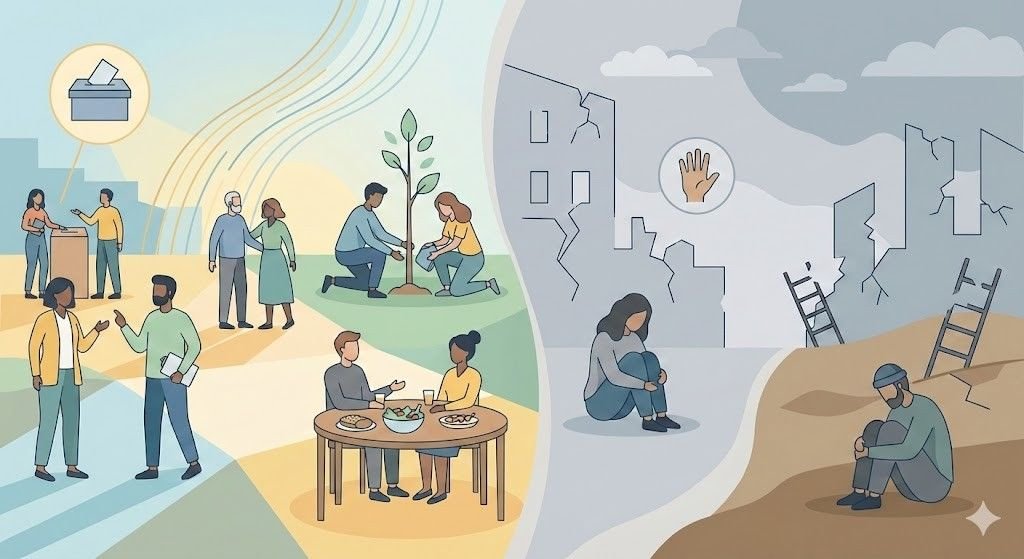
A system where everyone can be deceived, exploited, and oppressed—yet powerless to resist
Throughout the course of human civilization, the idea of building a “perfect abyss” has never been a mere fantasy. Its prototypes are scattered across history and present-day society—different in appearance, but strikingly similar in essence.
If one were to deliberately design such a society, three foundational principles must be strictly upheld: all wealth flows from one source, all power speaks from one voice, and all officials follow one chain of command.
I. Centralize all wealth, control the world
Money is the most fundamental unit of power and freedom in modern society. Whether a person can make independent choices largely depends on their basic economic capacity. Housing, education, healthcare, career paths—even the freedom to express opinions—all rest on a degree of financial autonomy. That is why restricting economic agency is one of the most effective ways to limit social freedom.
In a well-engineered abyssal society, people must never gain real control over economic resources.
The chronic financial vulnerability of the lower classes is not an accident—it is a structural reality. When people live paycheck to paycheck, drowning in debt and instability, they lose the capacity to reflect on systemic injustice, let alone organize to change it. Survival becomes their sole occupation.
And none of this is maintained by brute force, but rather by the quiet operation of a complex system—one that ensures that control over resources is always concentrated in the hands of a few. Tax policies favor capital, public resources are unevenly distributed, the education system rewards obedience, and the finance and housing sectors manufacture burden and dependency. Each seemingly neutral institutional design subtly funnels economic resources upward.
When people are consumed by survival—by housing near good schools, social insurance, and endless loan payments—they no longer have the strength to ask what freedom means, or what justice looks like.

II. Tame the citizens, preserve the throne
To crush political dreams, all it takes is turning citizens into obedient sheep.
The greatest threat to a deep-state society is not weapons, but the widespread awakening of civic consciousness. Once ordinary people realize they have the power to act collectively and participate in politics, the legitimacy of absolute power begins to crumble. That is why cutting off pathways for political participation becomes one of the system’s core strategies.
This suppression is not achieved through brute force, but through layered mechanisms—culture, education, media, and psychological conditioning—all working together to quietly neutralize resistance.
- From an early age, the education system frames politics as something that belongs to the upper ranks of society—instilling a belief that “politics is not something people like us can influence.”
- Mainstream media deliberately oversimplifies political issues and distances them from everyday life, aligning itself with those in power.
- Meanwhile, the public discourse is saturated with subtle suggestions that “getting involved in politics is tantamount to rebellion,” gradually turning civic engagement into something dangerous—something to be avoided.
This long-term shaping of information and cognition does not result in the silence of a generation, but rather in the “lack of political imagination” within it. People can no longer conceive of collective expression, democratic dialogue, or public action, and they find it increasingly difficult to trust or unite with others. Individuals gradually become atomized, losing the ability to form collective power.
Ultimately, citizenship is reduced to that of a “submissive individual”—no longer concerned with how the system operates, but only with how to avoid being harmed. In this state, even when widespread injustice exists, there is a lack of sufficient mobilization to push for change.
No need for suppression, no need for bullets—the system continues to function, because people have long since abandoned the possibility of fighting for change.

III. Control Through Bureaucracy: The System’s Grip on Power
Fostering “controllable talents” and making internal friction an institutional inertia.
In a highly centralized power system, maintaining long-term stability requires a bureaucratic structure loyal to the system, rather than to the people. In such a mechanism, those with independent judgment, a sense of public responsibility, and the courage to speak out are often excluded from the core. Instead, the system favors controllable talents—those who are deeply attached to power and have no moral boundaries when it comes to personal gain.
Some of them are addicted to power, some are driven by greed for money, and others are enslaved by personal desires. These “weaknesses” make them particularly easy to manipulate. The system places them in various power positions, where they become the boss in institutions, granted a paternalistic authority that forces peope to comply.
A deeper strategy is to create structural divisions and competition. By overlapping the authority of departments, leaving room for power struggles between local and central governments, and uneven resource allocation among officials, the system forces them into constant infighting within the institutional framework. This artificial mechanism of internal competition compels officials at all levels to expend vast amounts of energy on mutual surveillance and the struggle for limited resources, leaving little time for building consensus or pushing for reforms.
In the midst of this chaos, those in power only need to occasionally “mediate” to win hearts and establish authority. People may even come to appreciate the “arbiter of order,” despite the fact that they were the ones who created the very chaos. As the old saying goes, “The world is vast, yet it is like holding it in the palm of your hand.”

Finale: The Art of the Abyss
Building a “highly efficient yet dark society with no power to resist” does not require advanced technology, nor does it demand war or slaughter. It simply requires an understanding of human nature: make people fearful, foster internal strife, keep them poor, lead them to self-doubt, sow distrust among them, and then offer just a little bit of hope, sugar-coated distractions, or spiritual opiates.
In this way, millions can be reduced to silent sheep, walking through the abyss while believing that there is light above them and a path beneath their feet.
The true hell is not a place of blazing fire, but a world where everyone adapts, everyone accepts, and no one resists.