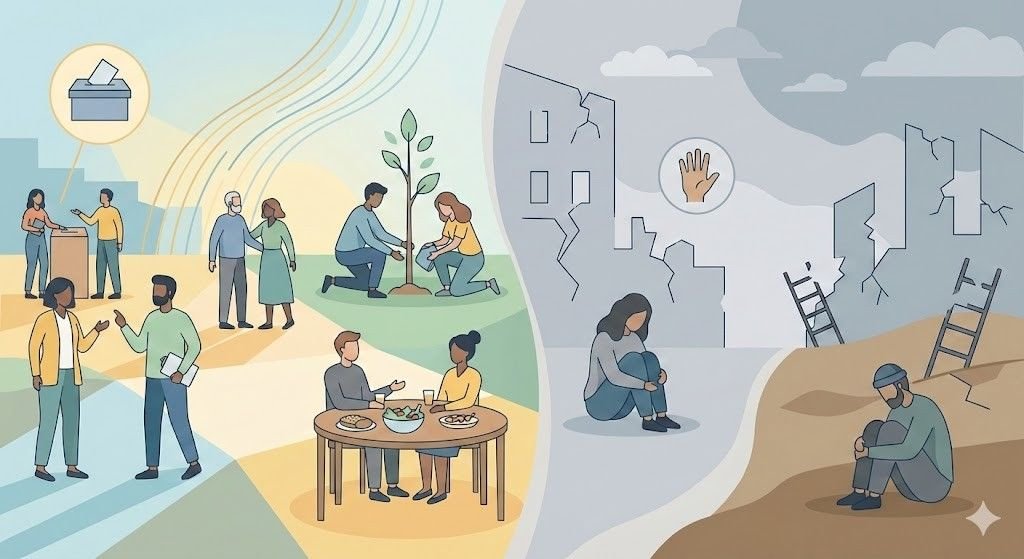
This passage emphasizes that the key to civilizational progress lies in systems, not technology. A system defines how social resources are organized and how power is structured. Its flexibility determines whether institutions can improve and whether technology can be used effectively—ultimately shaping the direction of civilization. A healthy system drives prosperity; a rigid one leads to collapse. Technology only serves the system.
Read MoreCategory: Civic Education

Three keys to civil society: power, responsibilities, and protection
One of the greatest advancements of civilization today is not just the height of technology or the prosperity of cities, but the fact that people are finally being seen as an end rather than a means. When individuals transition from being ruled and managed to becoming thinking, vocal, and responsible members of society, we step […]
Read MoreKey values of social citizenship: freedom, democracy, happiness
Civilizational shift and value reconstruction Human civilization is stepping into the “social citizenship era”—a time when people are more aware, systems are stable, and individual rights truly matter. From obedient subjects to national citizens, and now to social citizens, civilization is no longer measured by empires, power, or flashy technology—it is defined by new values […]
Read MoreThe Two Sides of Living: Democracy or Slavery
To be human is not just about biological survival, but about the growth of our spirit and soul. However, the meaning of “living” varies greatly at different stages of history and civilization. Some live in fear, oppression, and deception, simply striving to survive in chaotic times, indifferent to right or wrong. Others live in awakening, […]
Read MoreUnderstanding Civilization: The Dynamic Evolution of Human Morality
Civilization isn’t just about accumulating wealth or advancing technology。 It is an ongoing journey that stretches throughout human history, shaped by our constant search for good, justice, fairness, and order. While religion, philosophy, law, and social structures are visible aspects of civilization, the true force driving its evolution is humanity’s continuous questioning, refining, and redefining […]
Read MoreThe Loss or Renunciation of Civil Rights and Consequences
Civil rights are not only a symbol of an individual’s legal identity within the state, but also a crucial mechanism for ensuring personal dignity and the fair distribution of societal resources. These rights encompass participation in social governance, access to public services, and legal protection, all while carrying the responsibility of fulfilling social duties. However, […]
Read MoreCivic Studies: Transforming Civic Life for a Better Tomorrow
As an important concept in the history of human society, “citizen” signifies not just individual identity, but a collective responsibility and social awareness. Revolving around this awakening, civic studies explore how cooperation, participation, and responsibility undertaken among citizens can build a better society for all. Throughout history, humanity has moved from the production of individual labor […]
Read MoreThe Charm of Civic Quality Education
Future Education: Social Quality Education Will Break the Monopolies of Knowledge and Educational and Achieve a Shared Future Over the past few decades, education has been widely regarded as the primary path to success. However, traditional systems and methods of teaching have faced long standing issues. Knowledge and educational monopolies have concentrated quality resources among […]
Read More