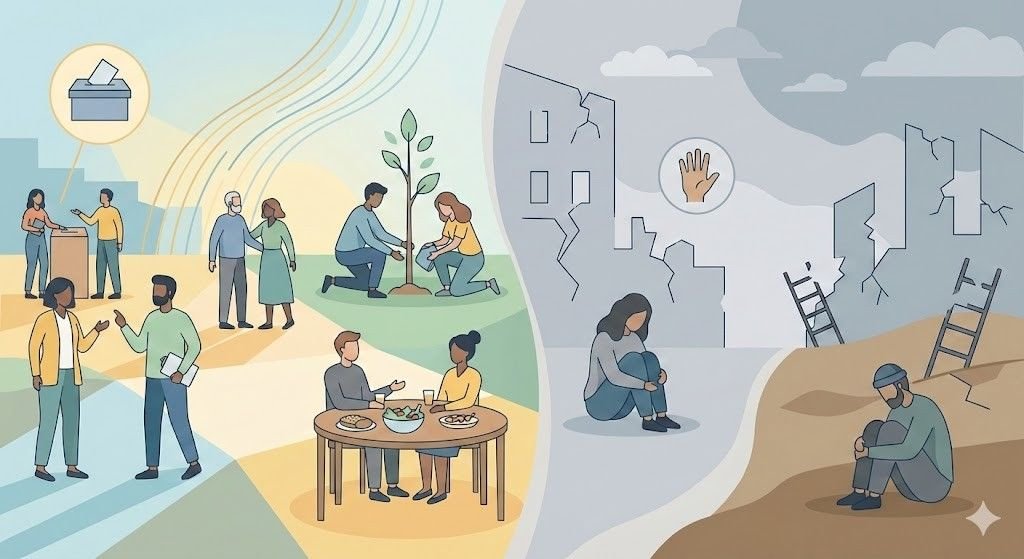
Without citizen sovereignty, there can be no true citizen state.
1. What is a state? What is a citizen?
A state is not merely a set of borders, institutions, regimes, or ruling authorities. In its modern form, a state is a political community voluntarily formed by a group of social citizens, organized around shared interests, common security, and collective visions for the future. Citizens are the foundation and core of the state. Without genuine citizens, a state loses its legitimacy as a political community and degenerates into a mere instrument of rule and coercion.
True citizenship is not defined solely by residence or possession of national identity documents. It is defined by the exercise of political sovereignty.
Only when individuals possess political sovereignty can they become true agents within the national community—able to decide, monitor, participate in, and place checks on the operation of state power. Only then does the state become “our state,” rather than a tool monopolized by a privileged few.
2. Historical depth: the evolution of the state and sovereignty
Looking back through human political history, the earliest forms of the state emerged from tribal alliances, military conquest, and territorial rule. These early “states” were held together by force and bloodline, with individuals stripped of rights and subjects possessing no sovereignty of their own.
In the age of feudal empires and theocratic regimes, political sovereignty was concentrated entirely in the hands of monarchs, popes, nobles, and clergy. The people were treated as livestock—powerless, disposable, and voiceless.
It was not until the rise of the modern nation-state—through the Enlightenment, bourgeois revolutions, and the creation of constitutional governments—that the idea of popular sovereignty and citizen political participation began to enter state structures. The French Revolution declared that “sovereignty belongs to the people.” The U.S. Constitution established a “government of the people” and a popularly elected legislature. From this point onward, the political legitimacy of modern states began to rest on the principle of citizen sovereignty.
Yet even today, truly citizen-sovereign states remain rare. In most countries, the idea of “rule by the people” exists only in name. In practice, power is still concentrated in the hands of a few, while citizens remain passive, subordinate, and politically excluded.
Where citizens are absent, sovereignty is hollow. Where sovereignty is hollow, the state decays—and with it, civilization stalls.
3. The true meaning of political sovereignty
Political sovereignty is not a symbolic clause in the constitution, nor is it limited to occasional elections. It is the genuine right of citizens to participate meaningfully in the operation of state power, the making of public decisions, the allocation of public resources, and the design of governance structures.
This system includes:
- Decision-making power: Citizens have the right to express opinions, propose ideas, and take part in decisions on major national issues—not merely to passively accept outcomes made by others.
- Oversight power: Citizens have the right to monitor the actions of the government, judiciary, military, and public institutions, holding them accountable and preventing abuse of power.
- Recall power: Citizens have the right to remove officials who violate public interests or harm citizens’ rights.
- Participation rights: Citizens should be able to engage widely in national affairs—whether through parliaments, civic organizations, public forums, or digital platforms—across domains such as law, economy, education, welfare, and environmental policy.
If a state allows only formalistic voting but denies citizens substantive political sovereignty, then the people become mere numbers, and the state becomes an oligarchy.
4. Without sovereignty, citizenship is just a lie
In today’s world, many countries claim to be “citizen-based,” but in reality, citizenship often exists only in name. Citizens are given legal identity, but not real power. They have no sovereignty and no true role in governing the country.
They carry obligations and pay the price, but are left out of the decision-making process, becoming mere subordinates of the state.
This means:
- Public resources are neither fairly nor transparently distributed, and decisions are made behind closed doors, allowing a small elite to monopolize the benefits meant for all.
- The legal system does not always protect equality. Some people enjoy privileges, while basic rights for the majority are often ignored.
- Policies are shaped by powerful interest groups. There is no strong system to protect public interest.
- Public opinion is manipulated and citizens have no real way to speak their minds.
This creates a troubling social structure: the state promises to put citizens first, but fails to treat them as true participants in public affairs.
When sovereignty slips from the hands of the people, the state loses its power to unite hearts and minds. Social trust begins to crumble, and the foundation of civilization starts to shake. In the end, such a nation no longer belongs to all its people—it becomes the private property of a privileged few, and its decline becomes irreversible.
5. The impact of lost sovereignty on a nation’s fate
History and reality both repeatedly prove this: any nation that strips its citizens of sovereignty will eventually fall into four major crises:
- Social fragmentation: When political power is overly concentrated and the public lacks channels for participation and oversight, social classes become rigid, and tensions between different groups cannot be resolved through institutional means. This may ultimately lead to deep division or even national disintegration.
- Crisis of legitimacy: A government’s legitimacy depends on citizens’ trust and sense of belonging. Once people are politically marginalized, collective identity weakens, and public trust in government declines. The regime is then forced to rely on coercion to maintain order, pushing the state into a crisis of rule.
- Collapse of public morality: When governance revolves solely around power and profit—rather than responsibility and the common good—public morality begins to erode. Core values like justice, fairness, trust, and accountability lose institutional support, leading to moral decline and social decay.
- National decline and collapse: History shows that whether empires or modern states, once they lose the support of the people, their systems of governance break down, and their social structures weaken, they become unable to respond to internal and external challenges—ultimately falling into irreversible decline or complete collapse.
6. The only path to a civilized future
If human civilization is to continue progressing, there is only one viable path: the full establishment of a modern state system based on citizen political sovereignty. This means:
- All state power must belong to the citizens, and political authority must be derived from their consent.
- Citizens must enjoy equal, open, and ongoing rights to political participation.
- A strict system of checks, balances, and accountability must be in place to prevent the privatization of power and the formation of political oligarchies.
- Public affairs must be transparent and open, allowing citizens to express their views in real time and receive meaningful responses and feedbacks.
- A citizen-led society must be built, advancing mechanisms for local governance, industry self-regulation, and community-level consultation.
Only through such a system can a nation truly become a citizen-based state—one that is stable, just, and prosperous. Only then can civilization continue to evolve.
Conclusion
Without citizen sovereignty, there can be no true citizen state.
A nation without the political sovereignty of its citizens becomes nothing more than a regime of elites and a machine of coercion.
A society without citizen sovereignty becomes a stage of oppression, exploitation, and hollow performances.
A civilization without citizen sovereignty is destined to fall into darkness, corruption, and collapse.
The true owners of a country can only be its civic citizens—those who hold political sovereignty in their own hands. The future belongs to the citizens: those who have the courage to awaken, to participate, to claim, and to defend their sovereignty.
This is the bottom line for the existence of any nation, and the final safeguard for the future of civilization.